OpenAI’s Endgame: Owning the OS, and Your Digital Identity
Collapsing apps, operating systems, and identity into one intelligent system.
OpenAI is on the verge of becoming the most dominant technology company of our era, much like Apple before it. The trajectory is clear: OpenAI will develop the next major operating system and hardware device, fundamentally reshaping how we interact with technology.
ChatGPT
ChatGPT was the first major clue. Its rapid evolution signals that OpenAI is laying the foundation for something much bigger. Currently, ChatGPT allows users to interact with specialized GPTs - essentially today's equivalent of apps. OpenAI has created a framework where users can build and refine their own GPTs for specific tasks, then publish them in a marketplace for others to use. This operates much like Apple's App Store, allowing for a vast expansion of capabilities within an integrated ecosystem. But I believe this is just the beginning. The search bar is evolving into the new command line or home screen. This integration is already beginning within ChatGPT - users can now press CMD-K to open a start menu, using the search bar to seamlessly open different conversations and GPT-powered applications. Instead of navigating fixed interfaces, users will simply describe their needs in plain English, prompting OpenAI to dynamically generate the right UI.
Today, multiple AI models run behind the scenes, but these distinctions will eventually disappear. Users won’t think about which model they're using. Instead OpenAI will automatically select the best one for each task, creating an experience that feels seamless and intuitive.
Early Indicators
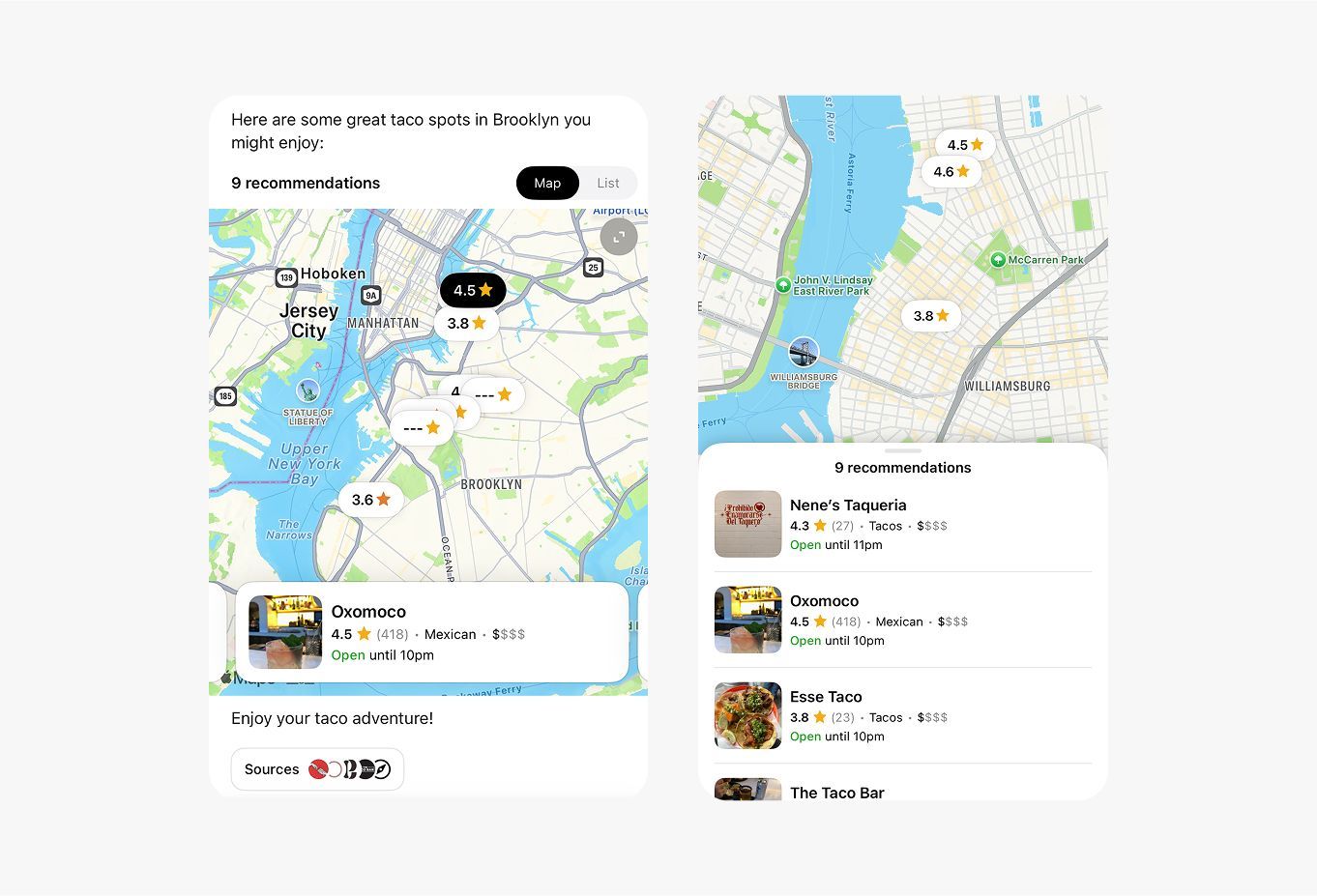
Early signs of this shift are already evident. Search for taco restaurants in New York within ChatGPT, and it renders an interactive map that adapts dynamically based on the query. Selecting a result provides deeper contextual layers, Level 2s (L2s), which will eventually replace third-party sources like Google Maps or Yelp, becoming native to OpenAI’s ecosystem.
Another practical indication of OpenAI’s expanding capabilities is in productivity software, where it will rival Google Workspace offerings like Docs and Sheets. Features like Canvas already allow users to draft, edit, and refine documents seamlessly using AI assistance, effectively turning a traditional word processor into an intelligent workspace. Similar innovations are emerging for spreadsheets and other productivity applications. This demonstrates yet another aspect of OpenAI’s vision - interfaces generated dynamically based on user intent and context, further illustrating the shift away from fixed, static tools toward adaptive, personalized experiences. As OpenAI expands these offerings, it could potentially become a significant competitor to Google Workspace, redefining productivity software through intuitive, AI-driven interactions.
Digital Identity and Social Profilicity
But this shift goes beyond search. OpenAI is constructing an interconnected digital identity system - a hybrid of an Instagram profile, Apple ID, and Linktree. Imagine your Apple ID not just as a login mechanism but as a deeply integrated part of your digital identity and social network. Users and businesses will curate OpenAI profiles, effectively mapping the entire internet into a dynamic, AI-powered knowledge network. Once profiles exist within OpenAI's GPT ecosystem, users can effortlessly discover and connect with each other, building a vast, AI-driven social network. Messaging, communication, and even live calls will leverage AI at the foundational level, enabling message summarization, multilingual conversations, and real-time translations seamlessly integrated into interactions. People might even use their AI-driven profiles to represent themselves and autonomously communicate on their behalf, enriching connections and digital interactions.
OpenAI’s ambitions in this space were playfully hinted at by CEO Sam Altman, who jokingly tweeted, "ok fine maybe we'll do a social app," in response to Meta’s announcement about launching their own AI app. While seemingly casual, this statement suggests a strategic recognition of the opportunity for OpenAI to expand further into social networking, deeply integrating AI, identity, and dynamic context.
The missing element in today’s digital experience is context. Your iMessage chat doesn't understand what you were just doing in your email. Your Instagram post doesn't integrate with your OpenTable reservation. These interactions exist in silos. OpenAI will unify them, merging apps, operating systems, and user interfaces into a single, intelligent environment. With AI-powered messaging and communication at its core, OpenAI will not only bridge these contexts but integrate our scattered digital conversations into one central, unified experience.
Our thoughts, ideas, and daily interactions stored across messages and communication channels will be dynamically linked, forming a comprehensive digital context. This unified experience will be deeply tied to the interconnected digital identity system, ensuring a cohesive and personalized digital presence across all interactions. Similar to 'Sign in with Apple' or 'Sign in with Google', your OpenAI profile could become a universal Single Sign-On (SSO) mechanism, linking one account to all services you interact with. Ultimately, it could even serve as a global, centralized standard for verifying identity.
Hardware
OpenAI isn’t stopping at software. The iPhone has remained fundamentally unchanged for 18 years. OpenAI has the opportunity to redefine this space. Jony Ive - the designer of the iPhone - is collaborating with OpenAI on a new hardware device, signaling that the company intends to build something radically new. This device and its operating system will integrate AI deeply from the ground up, rather than as a secondary consideration.
Interface Models
Jason Yuan envisioned Mercury OS in 2019 - a system responding fluidly to user intentions rather than forcing users to adapt to arbitrary app boundaries. This is precisely the paradigm OpenAI is pursuing. The idea of standalone apps will fade, replaced by companies like Airbnb, Uber, and Expedia functioning as APIs plugged into OpenAI’s operating system. Dynamic, purpose-built UIs will emerge based on real-time user needs.
Shopify has already demonstrated how standardization can drive conversions. Their checkout process is now the de facto standard for e-commerce because it works better than anything else. OpenAI will apply this principle across the board - why should we keep reinventing date pickers and flight booking flows? The OS will simply generate the most effective UI for any given task.
This transition is already underway. Companies like GitHub, Figma, and Galileo are experimenting with AI-generated UI, but they’re just scratching the surface. OpenAI’s recent partnership with CoFrame hints at a dedicated model for UI generation, one that will seamlessly integrate with their broader ecosystem. OpenAI has already built specialized models - Whisper for audio, DALL-E for images, GPT for text. The next natural step is a model for UI and interface generation.
Once OpenAI launches its own hardware, powered by a custom OS, the game changes entirely. This won’t be an iPhone or a Mac as we know it. It will be an AI-driven device that understands user intent and generates the right interface dynamically, based on what the user needs in that moment.
The shift is already happening, and soon, the way we think about apps, interfaces, and operating systems will be completely different. Beyond software and hardware, they will also own the digital footprint, shaping how people connect, affiliate, and interact online. OpenAI’s ecosystem will become the backbone of digital identity, integrating social connections, business networks, and personal data into a unified, operating system.